

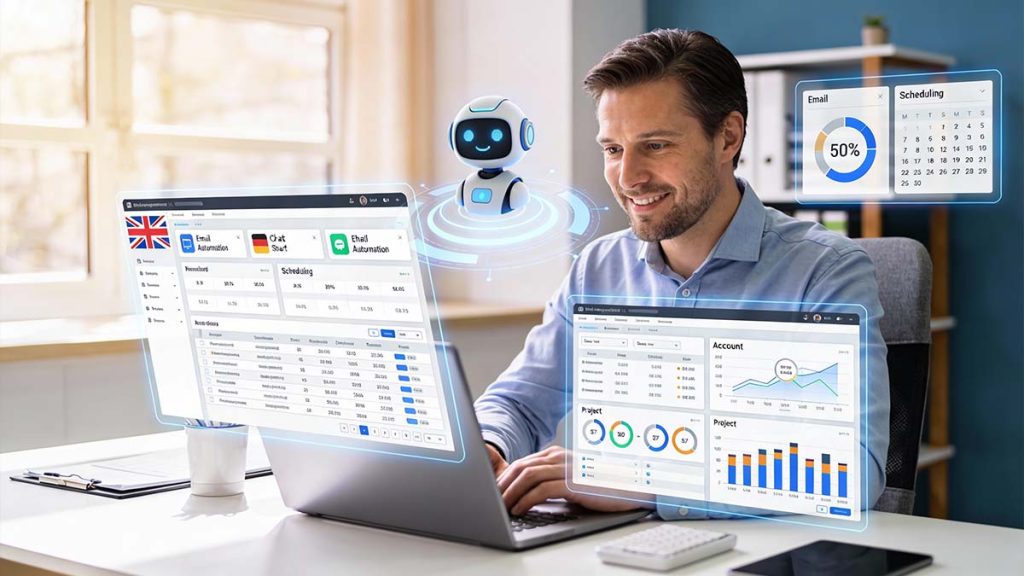
Artificial Intelligence (AI) is no longer limited to large tech companies. Today, small and medium-sized businesses are adopting AI tools to improve efficiency, reduce costs, and deliver better customer experiences. From marketing automation to data-driven decision-making, AI offers practical solutions that help businesses compete in increasingly digital markets.
Understanding how AI works and where it fits into daily operations can unlock significant growth opportunities for small businesses.
Understanding AI in the Business Context
Artificial Intelligence refers to computer systems designed to perform tasks that normally require human intelligence. These tasks include analyzing data, recognizing patterns, predicting outcomes, and automating repetitive processes.
For small businesses, AI typically appears in the form of:
- Automation software
- Customer service chatbots
- Predictive analytics tools
- Marketing personalization platforms
Rather than replacing human workers, AI often supports teams by handling repetitive work so employees can focus on strategy, creativity, and customer relationships.
Key Benefits of AI for Small Businesses
Implementing AI tools can significantly transform how small businesses operate. Even simple AI integrations can improve productivity and profitability.
1. Improved Customer Experience
AI helps businesses respond to customers faster and more accurately.
Examples include:
- AI chatbots that answer common questions instantly
- Personalized product recommendations
- Automated email responses and support tickets
These tools allow businesses to offer 24/7 support without hiring additional staff.
2. Better Data-Driven Decisions
AI tools can analyze large datasets quickly and identify patterns that humans may miss.
This helps businesses:
- Forecast demand
- Understand customer behavior
- Optimize pricing strategies
- Identify profitable products or services
With these insights, companies can make smarter strategic decisions based on real data rather than guesswork.
3. Increased Operational Efficiency
AI-driven automation eliminates repetitive manual tasks.
Common automated processes include:
- Inventory tracking
- Invoice processing
- Appointment scheduling
- Email marketing campaigns
By reducing administrative workload, businesses can save time and reduce operational costs.
4. Smarter Marketing Strategies
AI is transforming digital marketing by allowing businesses to target customers more effectively.
AI marketing tools can:
- Analyze audience behavior
- Optimize advertising campaigns
- Generate personalized content
- Predict customer purchasing patterns
This enables small businesses to run highly targeted campaigns with better return on investment.
Practical AI Tools Small Businesses Can Use
Several AI-powered platforms are designed specifically for small business needs. Many require little technical knowledge and are easy to integrate into existing systems.
Popular AI applications include:
Customer Support
- AI chatbots for websites
- Automated ticket systems
- Voice assistants
Marketing and Content
- AI writing tools
- Social media scheduling tools
- Automated email marketing
Sales and CRM
- AI-powered lead scoring
- Customer behavior prediction
- Smart sales recommendations
Operations
- Inventory management systems
- Fraud detection tools
- Automated accounting software
Using even a few of these tools can significantly improve efficiency and scalability.
Challenges Businesses Should Consider
While AI offers many advantages, businesses should also consider potential challenges.
Implementation Costs
Some advanced AI platforms can require:
- Software subscriptions
- Staff training
- Data integration
However, many affordable AI tools now operate on subscription models suitable for small businesses.
Data Privacy Concerns
Businesses must ensure that customer data is handled responsibly. This includes:
- Following privacy regulations
- Using secure software platforms
- Protecting sensitive information
Learning Curve
Teams may need time to learn how to use AI tools effectively. Providing training and gradually introducing AI systems can help employees adapt more easily.
The Future of AI in Small Business
Artificial Intelligence is expected to become a core component of business operations in the coming years. As technology becomes more accessible and affordable, even the smallest businesses will benefit from AI-powered insights and automation.
Future developments may include:
- More advanced predictive analytics
- Fully automated marketing campaigns
- Hyper-personalized customer experiences
- Voice and conversational AI for commerce
Businesses that start experimenting with AI today will be better prepared for the next phase of digital transformation.
Frequently Asked Questions (FAQ)
1. Is AI affordable for small businesses?
Yes. Many AI tools now offer affordable monthly subscriptions, making them accessible even for startups and small companies.
2. Do small businesses need technical expertise to use AI?
Most modern AI platforms are designed with user-friendly interfaces, meaning business owners can use them without advanced technical skills.
3. Can AI replace human employees in small businesses?
AI is mainly used to automate repetitive tasks. It usually supports employees rather than replacing them.
4. What is the easiest way for a small business to start using AI?
Starting with AI chatbots, marketing automation, or analytics tools is often the simplest approach.
5. How can AI improve marketing performance?
AI analyzes customer behavior, allowing businesses to target the right audience, personalize content, and optimize advertising campaigns.
6. Is customer data safe when using AI tools?
Data security depends on the platform used. Businesses should choose trusted providers and follow proper data protection practices.
7. What industries benefit the most from AI?
Retail, e-commerce, healthcare, finance, and marketing industries currently benefit the most, but AI is becoming useful across nearly every sector.

Comments are closed.